

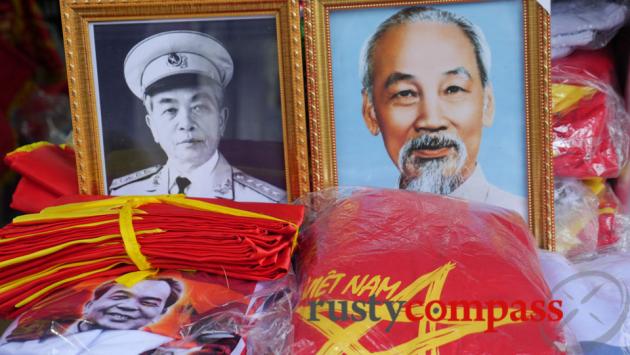
In the latest video in our series (see below) - America in Vietnam - a travel guide, we take a closer look at an event previously touched on in the first video of the series. The brief collaboration in the final months of World War II between Ho Chi Minh’s freshly formed Viet-Minh force and a team of US Intelligence Officers, must be one of the most twisted of twentieth century historical twists. The United States provided the first training and weapons for Ho’s Peoples’ Army of Vietnam - a force that would go on to complete its humiliation of the US military thirty years later in April 1975.
Humiliation wasn't the point. In fact Ho Chi Minh had courted the United States for decades.
In the final months of World War II, a team of US OSS Officers (precursor to the CIA) parachuted into Vietnam’s remote northern jungles, to train Ho Chi Minh’s men in the fight against the Japanese. A bond of respect and camaraderie was formed by the two fighting forces that offered no clue of the years of bloody conflict that lay ahead. The trainees included Vietnam’s most celebrated general, Vo Nguyen Giap, recognised to this day as one of the most effective military commanders of the twentieth century.
Our video also explores Ho Chi Minh’s extraordinary life prior to wars with the Japanese, the French and US-backed South Vietnamese government. His three decades abroad included time in the United States, the United Kingdom, France and the Soviet Union. In 1919, at the Versailles Peace Conference, he was rebuffed when he tried to deliver a petition to US President Woodrow Wilson, calling for self-determination for the Vietnamese people. That experience caused disillusionment and a drift to the writings of Lenin, who was sympathetic to the plight of colonised peoples. In the 1920s, Ho Chi Minh would become an important figure in the international Communist movement, first in Paris and then Moscow.
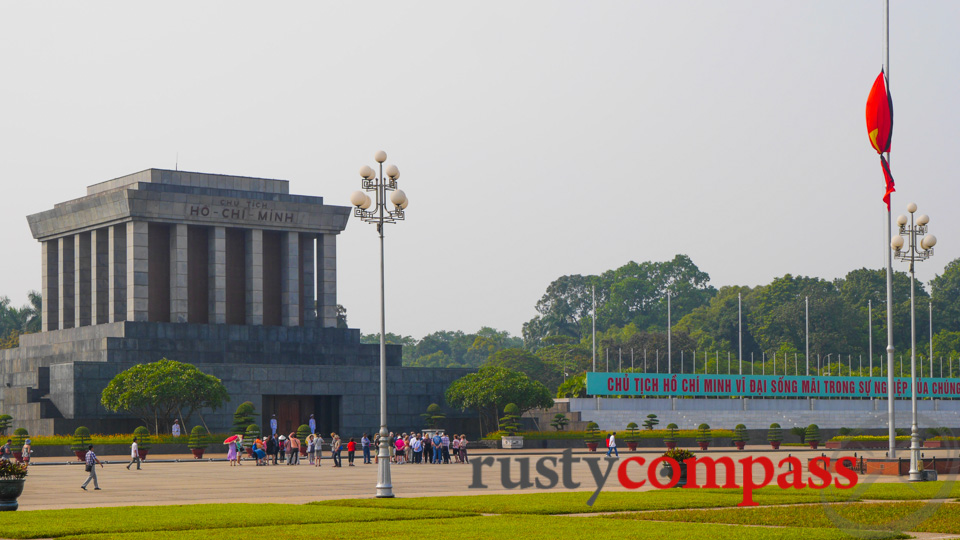
Photo: Mark Bowyer A tied Vietnamese flag at half mast overlooking Ho Chi Minh's Mausoleum marks the passing of General Vo Nguyen Giap in 2013
On his return to Vietnam in the 1940s, after decades away, Ho again tried to court the United States. On September 2nd 1945, now Vietnam’s national day, he quoted directly from the US Declaration of Independence in the preamble to his own independence speech delivered in Hanoi’s Ba Dinh Square.
The full text of Ho Chi Minh’s Declaration of Independence is a recommended read for travellers to Vietnam. It provides insights into the strategic brilliance and righteous fury that underpinned his success in winning the loyalty of millions among his countrymen and women. Read it before you explore Ho Chi Minh's Mausoleum, house on stilts and the Ho Chi Minh Museum - all in Ba Dinh Square where the independence declaration was delivered. Check the full text here.
Check out the full video above and the series on Rusty Compass or our YouTube channel.
Travel Tips.
Make sure you read Ho Chi Minh's Declaration of Independence before travelling to Hanoi. It will add great meaning to a visit to Ho Chi Minh's Mausoleum and his House on Stilts. If you're a true history nut, make sure you check out the Ho Chi Minh Museum. It was a gift to Vietnam from the Soviet Union right before its collapse in 1989. You can also visit the Old Quarter house where the Declaration was composed on Hang Ngang St in Hanoi's Old Quarter.



There are no comments yet.